Criterion-Based Rehabilitation Without Ignoring Tissue Healing
Key takeaway: Criteria show what a person can do today. Time and tissue stage show what the tissue may still be vulnerable to. The Rehab to Performance Pathway uses outcomes and criteria to decide when someone has earned the next stage.
This should not be a criteria-versus-time debate
Time alone is a poor rehabilitation plan. Reaching week six does not confirm that swelling is controlled, strength has returned or a task can be performed well. At the same time, passing a strength or hop test tells us about function. It does not by itself tell us how far healing tissue has progressed.
Criteria and timelines answer different questions. Criteria tell us what the person can demonstrate today. Time gives information about the biological stage and the exposures that may still carry disproportionate risk. A strong plan needs both.
What criterion-based rehabilitation improves
Criterion-based progression makes the reasons for advancing rehabilitation visible. After ACL reconstruction, for example, progression can be tied to effusion, range of motion, quadriceps function, movement quality and task performance rather than the calendar alone (1). That helps clinicians adjust for individual variation that a standard protocol hides.
Sport-specific rehabilitation frameworks take the same approach. The control-chaos continuum, developed by Taberner and colleagues from rehabilitation in elite English football, describes fitness development as criteria based rather than time dependent. It progresses from high control to high chaos and can be adjusted for the specific injury and estimated tissue healing times (2).
A criterion only makes sense next to an outcome. The outcome is the specific quality we are trying to change, or adaptation we are trying to produce such as:
Increased mobility in a certain joint
Improved muscular endurance
Enhanced maximal force
Reaching force faster (Rate of Force Development)
The outcome is not the patient's goal. While the criterion is the measurable evidence that the outcome has been reached: a test score against a chosen standard.
An outcome without a criterion gives a target but no objective way to know it has been reached. A criterion without an outcome is how we end up teaching to the test, such as progressing someone because they reached a symmetry score when symmetry was never what was limiting them.
The outcome comes first because it tells us what to train. The criterion is the checkpoint because it tells us when we have got there.
The Rehab to Performance Pathway: five stages
Knowing the outcome tells us what to change. We also need to know whether the person has the foundation to change it. Physical qualities build on each other, so the Pathway works through them in order. The stage name tells you where the person is, and the quality underneath it is the main outcome in that stage.
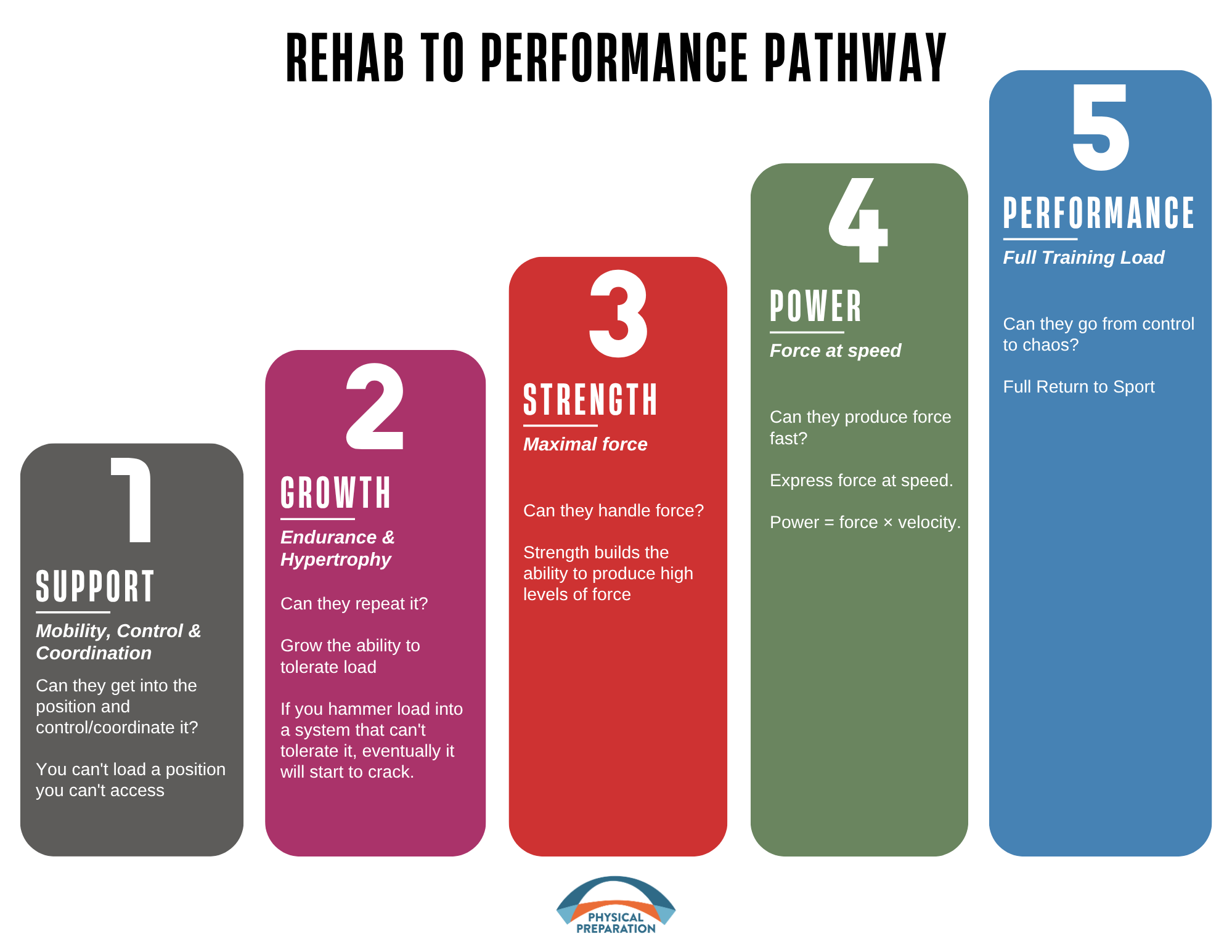
The Rehab to Performance Pathway. Each stage builds on the one below it, and the stages are not one way: if a quality drops, go back a stage.
Each stage is built on the one below it. Skip a stage and you are building on a gap. Four rules keep the model usable:
Each stage is the main focus, not the only thing trained. Someone working on strength can still do some mobility and some speed work.
Skipped stages tend to show up later. Power work on a shoulder that cannot tolerate volume, or heavy loading in a range the person cannot yet reach, is building on a gap.
The stages are not one way. If a quality drops, go back a stage. Like the Rehab to Performance checkpoints, the Pathway is dynamic, not linear: Progress, Revisit, Refine.
Not everyone starts at Support. The outcome and testing decide where a person enters, not the calendar or the exercise list.
The pieces fit together simply. The stages give the order. The outcome tells you which stage this person is in. The criterion tells you when they have earned the next one. Each stage has objectives (the outcomes) and exit criteria (the criteria) that need to be met before moving on.
Several clinical commentaries describe how this looks after ACL reconstruction. A ten-task progression moves a patient from walking through to complex sport movements, with specific criteria to meet before each task is started (3). A four-stage plyometric program is presented as part of criterion-based rehabilitation, matching task intensity to the person's functional recovery status (4). These papers combine theory, available evidence and the authors' clinical experience, so they offer structure rather than proof that a given sequence works.
The upper stages have support in the literature on residual deficits. A review reports deficits in maximal strength, rate of force development and reactive strength following several musculoskeletal injuries. It argues that rehabilitation should prepare athletes to tolerate loads and velocities across the force-velocity curve (5).
What criteria cannot tell us
Most clinical tests sample performance under specific conditions. They do not directly measure biological integrity. A person can produce an acceptable number while healing tissue remains vulnerable to a particular magnitude, rate or direction of load.
This matters most when the consequence of failure is high. In a prospective cohort of 106 athletes returning to pivoting sports after ACL reconstruction, each month that return was delayed up to nine months was associated with a 51 percent lower knee reinjury rate, with no further reduction after nine months (6). This was an observational study, so it does not show that waiting causes the benefit, and nine months is not a universal answer. It does show that time and accumulated preparation still carry information after criteria are introduced.
The numbers themselves can mislead too. Limb symmetry is a common criterion, but in a cohort of 70 athletes, 57 percent reached 90 percent symmetry on all measures six months after ACL reconstruction, while only 29 percent reached 90 percent of estimated preinjury levels (7). Symmetry can hide a loss on the uninvolved side. Test protocol, measurement error, compensation and task demands all affect interpretation.
Time sets the constraints, criteria individualize progress
The control-chaos continuum was built around this idea. Its authors describe it as being guided by pre injury running load targets while considering the injured tissues and the estimated status of healing (8). The updated version also acknowledges the balance between risk and reward in elite football. Players may return to competition without having met every progression criterion, and the authors advise tailoring the model to each injury case (9).
The approach has been carried into other settings. The continuum has been adapted for on-court rehabilitation in basketball (10). In a single case report of an elite female footballer after ACL reconstruction, the authors describe using strength and power tests from early in rehabilitation to quantify willingness to load the involved limb, the effect of progressive loading, and asymmetries relative to preinjury data where available (11). A single case cannot show that this approach works, but it shows what criterion testing can look like in practice.
In my view, time and criteria do different jobs. I use time to respect tissue constraints, I use criteria to individualize progress, and I use the response to exposure to connect the two. Tissue and healing constraints apply across all five stages. They set what is appropriate within a stage, and the criteria decide whether the person has earned the next one.
Criteria work best as converging evidence. Before I progress someone, I want to see that they meet the threshold, that the result is trustworthy, that the strategy is acceptable, that the response is stable and that the test represents something relevant to the next stage.
The practical question is not "time or criteria?" It is "What evidence do I need before adding this specific demand, and what biological constraints still shape that decision?"
Research is only useful when it changes what you do. Each edition of Checkpoint connects useful evidence with insights from rehabilitation, testing and performance to help you make more informed decisions in practice.
References
Adams, D., Logerstedt, D., Hunter-Giordano, A., Axe, M. J., & Snyder-Mackler, L. (2012). Current concepts for anterior cruciate ligament reconstruction: A criterion-based rehabilitation progression. Journal of Orthopaedic & Sports Physical Therapy, 42(7), 601-614. https://doi.org/10.2519/jospt.2012.3871
Taberner, M., Allen, T., & Cohen, D. D. (2019). Progressing rehabilitation after injury: Consider the 'control-chaos continuum'. British Journal of Sports Medicine, 53(18), 1132-1136. https://doi.org/10.1136/bjsports-2018-100157
Buckthorpe, M., Tamisari, A., & Della Villa, F. (2020). A ten task-based progression in rehabilitation after ACL reconstruction: From post-surgery to return to play - A clinical commentary. International Journal of Sports Physical Therapy, 15(4), 611-623. https://doi.org/10.26603/ijspt20200611
Buckthorpe, M., & Della Villa, F. (2021). Recommendations for plyometric training after ACL reconstruction - A clinical commentary. International Journal of Sports Physical Therapy, 16(3), 879-895. https://doi.org/10.26603/001c.23549
Maestroni, L., Read, P., Bishop, C., & Turner, A. (2020). Strength and power training in rehabilitation: Underpinning principles and practical strategies to return athletes to high performance. Sports Medicine, 50(2), 239-252. https://doi.org/10.1007/s40279-019-01195-6
Grindem, H., Snyder-Mackler, L., Moksnes, H., Engebretsen, L., & Risberg, M. A. (2016). Simple decision rules can reduce reinjury risk by 84% after ACL reconstruction: The Delaware-Oslo ACL cohort study. British Journal of Sports Medicine, 50(13), 804-808. https://doi.org/10.1136/bjsports-2016-096031
Wellsandt, E., Failla, M. J., & Snyder-Mackler, L. (2017). Limb symmetry indexes can overestimate knee function after anterior cruciate ligament injury. Journal of Orthopaedic & Sports Physical Therapy, 47(5), 334-338. https://doi.org/10.2519/jospt.2017.7285
Taberner, M., Allen, T., O'Keefe, J., Chaput, M., Grooms, D., & Cohen, D. D. (2025). Evolving the control-chaos continuum: Part 1 - Translating knowledge to enhance on-pitch rehabilitation. Journal of Orthopaedic & Sports Physical Therapy, 55(2), 78-88. https://doi.org/10.2519/jospt.2025.13158
Taberner, M., Allen, T., O'Keefe, J., Chaput, M., Grooms, D., & Cohen, D. D. (2025). Evolving the control-chaos continuum: Part 2 - Shifting "attention" to progress on-pitch rehabilitation. Journal of Orthopaedic & Sports Physical Therapy, 55(3), 162-172. https://doi.org/10.2519/jospt.2025.13159
Taberner, M., Spencer, N., Murphy, B., Antflick, J., & Cohen, D. D. (2023). Progressing on-court rehabilitation after injury: The control-chaos continuum adapted to basketball. Journal of Orthopaedic & Sports Physical Therapy, 53(9), 498-509. https://doi.org/10.2519/jospt.2023.11981
Taberner, M., van Dyk, N., Allen, T., Jain, N., Richter, C., Drust, B., Betancur, E., & Cohen, D. D. (2020). Physical preparation and return to performance of an elite female football player following ACL reconstruction: A journey to the FIFA Women's World Cup. BMJ Open Sport & Exercise Medicine, 6(1), e000843. https://doi.org/10.1136/bmjsem-2020-000843