Why Rehabilitation Should Prepare People for Demand, Not Just Settle Symptoms
Key takeaway: Symptoms tell us how a person is responding to load. They do not tell us whether the person can tolerate, produce and repeat what their task demands. Define the demand first, then judge progress against it.
The problem with making symptoms the finish line
A reduction in pain is valuable. Pain and sleep disturbance influence each other (1), and fear of pain can drive avoidance of movement (2), so reducing pain can support sleep, confidence and willingness to move. It can also create the impression that rehabilitation is finished before the person is ready for what comes next.
Symptoms and capacity are related, but they are not interchangeable. Consider three examples. A runner may walk daily without pain and still lack the calf capacity for repeated ground contacts. A field-sport athlete may have a quiet knee in clinic and still be underprepared for deceleration and unplanned change of direction. A worker may feel fine during a controlled exercise session and still be unable to repeat lifting tasks across a full shift. These are clinical illustrations, not research findings.
So I do not think the central question should be "How do we make this hurt less?" The better question is "What does this person need to be able to tolerate, produce and repeat?" Symptoms remain part of the answer. They should not be the whole target.
Start by defining demand
Demand is broader than one movement or one peak force. It includes the environment, the task, the outputs required and how those outputs must be executed. A cutting task changes when it is planned or reactive, fresh or fatigued, performed once or repeated. A lift changes when it is done once in a quiet gym or repeatedly through a work shift.
The 2016 Bern consensus statement on return to sport framed return as a continuum, from return to participation, to return to sport, to return to performance (3). That distinction matters clinically. Participation can be possible well before previous performance is restored, so clearance for one stage should not be read as readiness for the next.
Defining demand is the step most often skipped in my experience. Without it, a program has no direction, and criteria get chosen because they are convenient rather than because they match the task.
Once the demand is clear, the next step is to name the quality that has to change to meet it. I call that the outcome: the adaptation we are trying to produce, such as mobility, endurance, strength or power. It is not the patient's goal. The criterion is the measurable evidence that the outcome has been reached, a test score against a standard. The outcome tells us what to train. The criterion tells us when we have got there.
Symptoms are information, not a complete readiness test
Symptoms help us judge irritability, response to loading and whether the current dose suits the person. They do not directly measure strength, power, rate of force development, movement strategy, aerobic capacity or tolerance to repeated exposure.
That is not an argument for pushing through pain, and it does not make pain irrelevant. Mechanical loading is an important driver of tissue repair and adaptation, and tissues respond differently to it (4). Tissue involved, stage of healing, current capacity, previous exposure and the consequences of error all shape the decision. The aim is an appropriate load, applied at the right time, with a response that allows progression.
In practice I follow a 24 hour response as feedback on dose, then judge readiness separately against the demand.
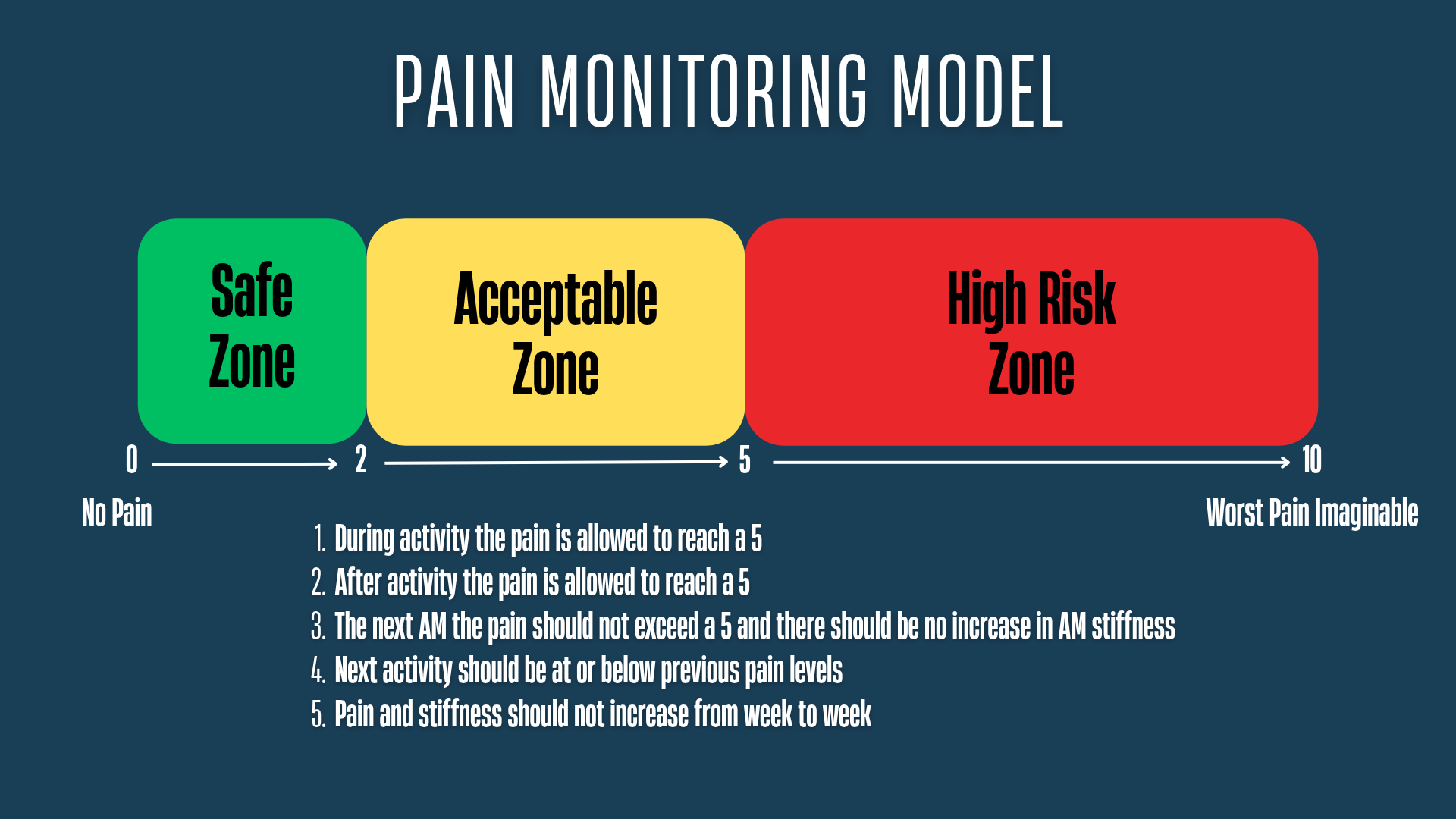
Figure 1. Pain monitoring model. Pain is tracked during and after activity, the next morning, at the next session and week to week against a 0 to 10 scale. Source: Adapted from Silbernagel and Crossley (5), who proposed the model for midportion Achilles tendinopathy.
Build from tolerance to capability
Early rehabilitation often begins by restoring tolerable movement and basic function. That is appropriate. The problem is staying there. As irritability settles, the program should increasingly resemble the outputs and exposures the person needs outside the clinic.
I think about four questions:
What can the person tolerate now?
What can they produce?
What can they repeat?
How closely does the current task resemble the eventual demand?
Progression is rarely linear, because symptoms, confidence, fatigue and performance fluctuate. Rehabilitation therefore needs a feedback loop: expose, assess the response, adapt the dose and retest. Practical frameworks for progressing load, such as considering how much, how fast and how soon, give that loop some structure (6). The destination stays stable even when the route changes.
What this changes in practice
Symptom reduction is an important result, but it is not proof that demand can be met. I would consider rehabilitation complete when there is a reasonable match between current capability and the demands the person intends to resume, with an acceptable level of uncertainty and risk. A quieter knee is useful. A knee that can tolerate the required force, speed, volume, variability and context is the actual goal.
If you want to keep working through how to define demand, test it and progress toward it, Join Checkpoint for new research-to-practice articles from Physical Preparation.
References
Finan, P. H., Goodin, B. R., & Smith, M. T. (2013). The association of sleep and pain: An update and a path forward. The Journal of Pain, 14(12), 1539-1552. https://doi.org/10.1016/j.jpain.2013.08.007
Vlaeyen, J. W. S., & Linton, S. J. (2012). Fear-avoidance model of chronic musculoskeletal pain: 12 years on. Pain, 153(6), 1144-1147. https://doi.org/10.1016/j.pain.2011.12.009
Ardern, C. L., Glasgow, P., Schneiders, A., Witvrouw, E., Clarsen, B., Cools, A., Gojanovic, B., Griffin, S., Khan, K. M., Moksnes, H., Mutch, S. A., Phillips, N., Reurink, G., Sadler, R., Grävare Silbernagel, K., Thorborg, K., Wangensteen, A., Wilk, K. E., & Bizzini, M. (2016). 2016 consensus statement on return to sport from the First World Congress in Sports Physical Therapy, Bern. British Journal of Sports Medicine, 50(14), 853-864. https://doi.org/10.1136/bjsports-2016-096278
Khan, K. M., & Scott, A. (2009). Mechanotherapy: How physical therapists' prescription of exercise promotes tissue repair. British Journal of Sports Medicine, 43(4), 247-252. https://doi.org/10.1136/bjsm.2008.054239
Silbernagel, K. G., & Crossley, K. M. (2015). A proposed return-to-sport program for patients with midportion Achilles tendinopathy: Rationale and implementation. Journal of Orthopaedic & Sports Physical Therapy, 45(11), 876-886. https://doi.org/10.2519/jospt.2015.5885
Gabbett, T. J. (2020). How much? How fast? How soon? Three simple concepts for progressing training loads to minimize injury risk and enhance performance. Journal of Orthopaedic & Sports Physical Therapy, 50(10), 570-573. https://doi.org/10.2519/jospt.2020.9256