When Strength Symmetry Can Hide Bilateral Deficits
Key takeaway: A limb symmetry score tells you the two limbs are similar today. It does not tell you whether they are both strong enough for the task, or whether the person moves the same way on both sides. Use symmetry alongside absolute values, previous data and movement strategy.
A symmetry score is a comparison, not a diagnosis
A limb symmetry index divides one limb's score by the other's. It is easy to calculate and easy to explain to an athlete, a coach or a surgeon, which is why it is such a common return-to-sport criterion. But it only tells us that two measured outputs were similar, or were not, under one protocol on one day. It does not tell us why, whether the difference matters or whether the person was symmetrical before the injury.
When the reference limb has lost capacity too
The index usually compares the involved limb with the uninvolved limb. After injury and surgery, activity drops and both limbs can lose capacity. If the uninvolved limb has declined, the involved limb can reach 90 percent of it without being close to the person's previous level.
One ACL cohort shows how this can play out. In a prospective cohort of 70 athletes tested six months after ACL reconstruction, 57 percent met a 90 percent symmetry threshold on quadriceps strength and four hop tests. Only 29 percent met the same threshold when the involved limb was compared with the uninvolved limb tested before surgery, an estimate of preinjury capacity (1). The authors concluded that limb symmetry indexes frequently overestimate knee function.
The loss is not always confined to the injured side. A review of strength and power training in rehabilitation notes research reporting that muscle strength is impaired bilaterally, and below normative data, in runners with Achilles tendinopathy (2). Symmetry cannot flag a deficit that is present on both sides.
When preinjury data exist, they give a better reference than the other limb. In a case report of an elite female footballer after ACL reconstruction, the authors describe testing strength and power from early in rehabilitation and comparing asymmetries and deficits with preinjury data where available, or with sport- or phase-specific reference data (3). Most clinicians will not have preinjury data. In that case, absolute values and appropriate reference data are the next best anchor, with the caution that reference data come from other populations.
Nine ways to calculate the same difference
Even the arithmetic is not settled. A review of the strength and conditioning literature found nine different equations in use for between-limb differences (4). A more recent commentary from the same group puts the figure at roughly ten equations since the early 1980s. It notes that until 2016 most studies did not ask whether their equation was appropriate and often cited an earlier paper as the justification (5).
The original review shows the problem with a hypothetical example: one limb jumps 25 cm and the other 20 cm. Depending on the equation, the "asymmetry" comes out anywhere from 7 to 22 percent, and one equation returns 80 percent because it reports symmetry rather than asymmetry (4).
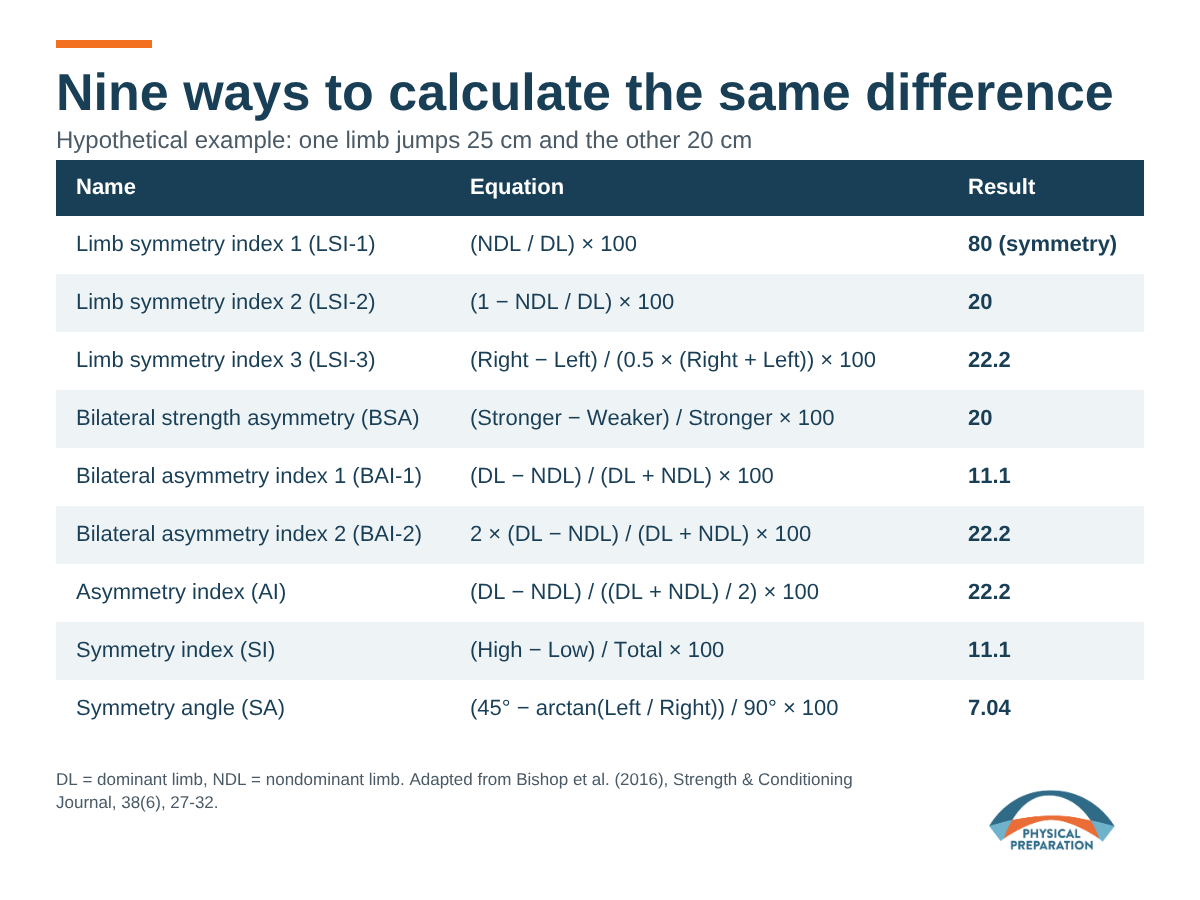
The same hypothetical example, one limb jumping 25 cm and the other 20 cm, run through nine equations. The asymmetry results range from 7.04 percent (symmetry angle) to 22.2 percent (LSI-3, BAI-2 and AI). LSI-1 returns 80 because it reports symmetry rather than asymmetry. DL is the dominant limb and NDL the nondominant limb. Adapted from Bishop et al. (4).
The first review favoured the symmetry angle (4). The group's more recent position is simpler. A relative difference is a fraction, so it should follow ordinary percentage arithmetic, which points to the bilateral strength asymmetry equation: the difference divided by the larger value (5). They note that LSI-2 gives the same 20 percent here but cannot be relied on, because there is no guarantee the dominant limb will always score higher (5). For bilateral tests, such as comparing each leg's share of total force in a two-legged jump, they suggest an equation relative to the total instead, either BAI-1 or SI (5, 6).
Because the bilateral strength asymmetry equation always puts the stronger limb first, the answer is always positive and the direction is lost. The original review noted this as a problem for tracking someone over time (4). It is one reason the side has to be recorded separately.
The practical point is that two papers using different equations are not directly comparable, and neither are their thresholds (6). Whichever equation you use, write it down.
The same percentage can describe different problems
A ten percent difference in peak force is not the same as a ten percent difference in early impulse, eccentric braking or repeated hop performance. The metric, the direction and the task all matter. So does the denominator, because percentages become unstable when the values are small.
A person can also favour one limb for producing force and the other for absorbing it, so a single asymmetry label can lose useful information. Reducing a battery of tests to one number loses it too.
Two further checks help. First, the difference should be larger than the test's own measurement error before it is treated as real. The Lessons paper suggests comparing the asymmetry with the coefficient of variation of the measure, and says an asymmetry that exceeds the error still does not automatically need fixing (5). Second, the direction matters as well as the size. In 28 recreational athletes, jump asymmetries on average favoured the left limb while isometric squat asymmetries favoured the right, and agreement on which side was stronger across tests ranged from slight to substantial. The authors concluded that an individual approach to asymmetry is needed (7). That was a healthy group, so it shows how variable the measure is rather than how an injured limb behaves.
In rehabilitation the involved limb is usually the lower one early on, so the direction looks obvious. The Lessons paper makes the point that once the limb is no longer injured, direction can change. Its example is an athlete who goes from 6.5 percent in favour of the right limb to 2.0 percent in favour of the left. That is an 8.5 percent shift, not a 4.5 percent reduction, and it is missed if only the absolute value is tracked (5). The same paper notes that a consistently weaker limb is a reasonable prompt for further discussion and a chance to build capacity (5).
Is there a magic threshold?
Studies in ACL and general populations have suggested that asymmetry beyond 15 percent, and more recently beyond 10 percent, marks a higher risk of injury. The Lessons paper calls a universal threshold an inherently flawed idea, because asymmetry is task-specific and a test that does not give the same score from one session to the next cannot predict much (5). A practitioner article on thresholds reaches a similar view. It suggests reading the percentage alongside the coefficient of variation and monitoring the direction of asymmetry instead (8). In 203 professional male soccer players, asymmetry scores varied widely across tests and physical qualities, from 5.2 to 14.5 percent in the screening results, and the authors concluded that no single threshold applied to all tests (9).
Equal results can come from different strategies
Two limbs can reach a similar result in different ways. In a laboratory study of 26 athletes after ACL reconstruction and 23 uninjured controls, single leg hop distance was about 97 percent symmetric. Knee work during propulsion was only about 69 percent symmetric. The involved knee absorbed less work in landing, and the athletes made up for it with more hip work and more hip and trunk flexion (10). The authors concluded that hop distance symmetry does not mean symmetry in lower limb biomechanics.
Most clinics cannot measure joint work, so this will not change what is on the testing sheet. It does show why the number alone can be too reassuring, and why it is worth watching how a result is produced as well as how far or how heavy it is.
Does asymmetry itself matter?
The evidence for asymmetry as a cause of poor performance or injury is weaker than the amount of testing suggests. A systematic review of 18 studies found that between-limb differences in strength may be detrimental to jumping, kicking and cycling. Findings for change of direction speed were mixed, and every study was associative, with no randomized trials (11). A narrative review concluded that injuries tend to accentuate asymmetries, but found no evidence that pre-existing asymmetries increase injury risk, and no evidence that reducing asymmetry improves sport-specific performance or lowers injury risk (12). The Lessons paper describes a systematic review of asymmetry and injury risk in which about a third of studies found some risk, a third found none and a third were inconclusive (5).
That does not make symmetry unimportant. Restoring capacity remains an obvious priority in rehabilitation, and doing so tends to reduce an imbalance over time (5). It means a symmetry score is weak evidence on its own, in either direction.
How I interpret an asymmetry
When an asymmetry appears, I ask a short set of questions. Is the test reliable enough to trust the difference? Is the difference larger than typical measurement variation? Does it show up across trials and sessions? Is the involved side below an appropriate absolute target? Does it appear in a quality that matters for what the person needs to do? Do the movement strategy or the symptom response help explain it? Would changing this finding change the program?
This turns asymmetry into a starting point for reasoning rather than a pass-fail label. Sometimes the answer is targeted unilateral loading. Sometimes it is bilateral capacity development, because both sides are short of what the task needs. Sometimes it is exposure to a specific skill, and sometimes the difference is monitored and left alone.
In the Rehab to Performance Pathway, a symmetry score can be one of the criteria for leaving the Strength stage. I would not let it be the only one. The question I want answered is not "Are the limbs identical?" It is "Does this difference help explain the current limitation, or change what we need to do next?"
Symmetry is one piece of evidence. It becomes useful when I read it next to the absolute values, the movement strategy and what the person needs to be able to do. Working through that kind of reasoning, one paper or one test at a time, is what I try to do whenever I write about research.
Checkpoint is research and reasoning from me, sent when there's something worth sharing.